
The one-cent coin issued in 1967 belongs to the Lincoln Memorial series featuring the monument on the reverse.
This mintage occurred during a period of temporary absence of mint marks on all American coinage.
The US Treasury Department decided to remove mint location designations, preventing mass hoarding of coins from circulation by private individuals.
Despite the lack of letter indices, the minting process took place at three facilities: Philadelphia, Denver, and San Francisco.
The total mintage amounted to 3,048,667,100 specimens — all the info affects the 1967 penny value.
Parameter | Value |
Composition | 95% Copper, 5% Zinc |
Weight | 3.11 grams |
Diameter | 19.05 mm |
Edge Type | Plain |
Obverse Designer | Victor David Brenner |
Reverse Designer | Frank Gasparro |
The pure copper content in the alloy causes interest in the coin as a metal source during rising commodity prices.
The value of copper within one cent often exceeds its face value, reaching 2.5–3 cents depending on market conditions.
Preservation Categories and Color Classification
The numismatic value of 1967 specimens depends directly on the surface condition and preservation of natural luster.
Professional grading services (PCGS, NGC) utilize three primary color categories for copper coins.
Brown (BN). Specimens losing more than 95% of their original luster.
These coins appear in circulation everywhere.
The market value of most BN samples remains at face value.Red-Brown (RB). Coins retaining between 5% and 95% of the original copper color.
The value of samples in MS63-MS64 RB condition varies from 1 to 5 dollars.Red (RD). Specimens retaining more than 95% of the bright mint luster.
High auction prices are recorded specifically within this category.
Survival Statistics in High Grades
The massive mintage of 1967 led to the wear of working dies, reducing the number of coins in perfect condition.
According to the PCGS Population Report and the coin value checker app, the distribution of surviving specimens in Mint State condition is as follows.
MS65 RD: Over 4,000 units registered. The price is approximately 15–20 dollars.
MS66 RD: About 1,200 units registered. Market value stays in the 45–60 dollar range.
MS67 RD: A rare category including fewer than 150 confirmed specimens. The value reaches 400–700 dollars.
MS67+ RD: An exceptionally rare degree of preservation numbering only a few units.
Auction Records and Price Dynamics
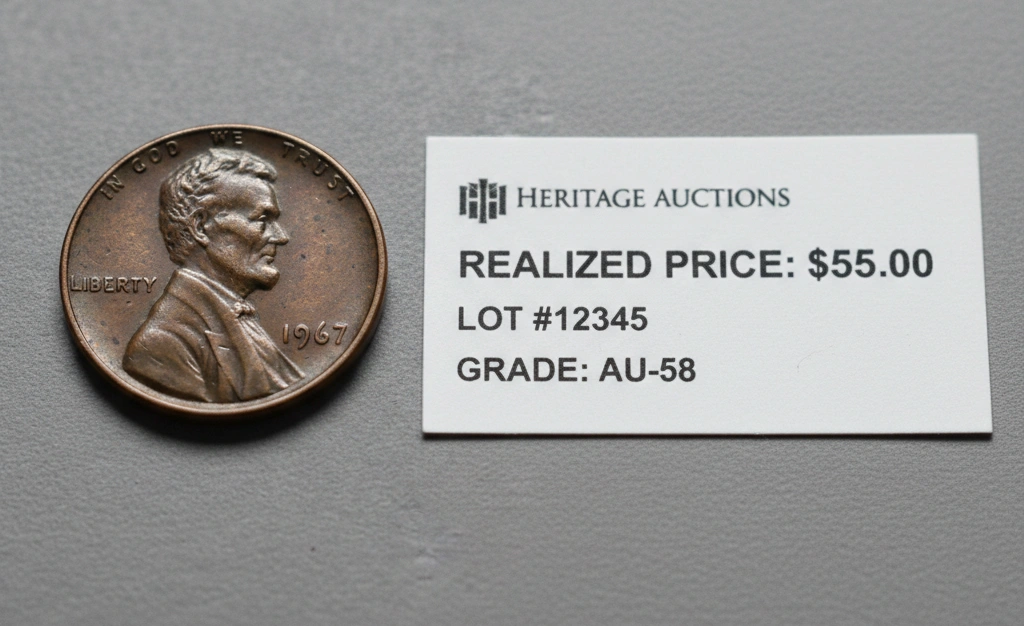
Analysis of sales at Heritage Auctions and Stack’s Bowers reveals a significant gap between common and elite specimens.
In 2008, a 1967 specimen in PCGS MS67 RD grade sold for 1,035 US dollars.
In 2014, a similar coin in the same preservation recorded a price decrease to 705 dollars.
The highest result was achieved in 2019, seeing a 1967 cent in MS67+ RD condition sold for 5,500 US dollars.
The average annual price change for coins in MS65 RD condition demonstrates stability with a deviation of no more than 2% per year.
For rare MS67 grades, price volatility reaches up to 15% depending on the number of new lots entering the market after grading.
Special Mint Sets (SMS)
The US Mint did not produce Proof sets in 1967.
Instead, Special Mint Set (SMS) kits were manufactured, featuring higher striking quality compared to regular business strikes.
Dies for SMS underwent sandblasting, creating a satin or matte surface.
SMS Grade | Estimated Market Price |
MS65 RD SMS | $3 - $5 |
MS67 RD SMS | $15 - $25 |
MS68 RD SMS | $150 - $200 |
SMS specimens with a Cameo (CAM) or Deep Cameo (DCAM) contrast effect are valued significantly higher due to their rarity in this issue.
The record for a 1967 SMS Lincoln Cent in SP68 DCAM condition is 4,025 US dollars, established at auction in 2004.
Minting Errors and Varieties
Technological failures during production created specific varieties interesting to researchers.
Doubled Die Errors. No significant Double Die Obverse (DDO) errors comparable to 1955 or 1972 were recorded in 1967.
Micro-doublings exist, being detectable only under 40x magnification.
These defects do not add substantial value, increasing the price by 5–10 dollars.
Planchet Errors. Finding 1967 cents struck on 10-cent (dime) planchets is an extremely rare fact.
The weight of such a coin is 2.27 grams instead of the standard 3.11.
The cost of such errors at auctions fluctuates from 400 to 1,200 dollars.

Off-Center Strikes. Coins with an off-center shift exceeding 50% while retaining the date are valued at 50–150 dollars.
Shifts under 10% occur frequently, representing no numismatic interest.
Broadstrikes. Specimens having an increased diameter due to the absence of the retaining collar during striking cost from 20 to 50 dollars depending on preservation.
Investment Analysis and Liquidity
Liquidity for 1967 coins in grades below MS66 RD is assessed as low.
The vast quantity of surviving samples precludes a shortage in the mass segment.
For investors, only positions from the top tier of registries (Top Pop) present interest.
According to statistics, the number of coins in MS67 RD grade increases by 3–5 units annually thanks to the opening of old bank rolls and subsequent certification.
This gradual increase in supply restrains sharp price growth.
Condition | Raw (No Certificate) | PCGS/NGC Certified |
Uncirculated (Typical) | $0.10 - $0.30 | $10 - $15 |
Choice Unc | $0.50 - $2.00 | $25 - $40 |
Gem Unc (MS65) | $5.00 - $10.00 | $15 - $25 |
Factors Affecting Value Degradation
Copper is an active metal subject to oxidation upon contact with oxygen and moisture.
A 1967 coin stored in improper conditions transitions quickly from the Red category to Red-Brown.
Losing the RD category reduces the value of an elite specimen by 70–90%.
Using PVC containers leads to the appearance of green corrosion spots, completely nullifying the numismatic premium.
Comparison with Adjacent Mintage Years
Understanding the market position of 1967 requires comparing it with the 1966 and 1968 mintages.
1966 Year: Mintage 2.1 billion. Record MS67 RD price — about 2,800 dollars.
1967 Year: Mintage 3.0 billion. Record MS67+ RD price — 5,500 dollars.
1968 Year (S): Mintage 258 million. Record MS67 RD price — about 300 dollars.
Despite having the largest mintage in this trio, the year 1967 demonstrates the highest peak prices for specimens in perfect condition.
This is explained by the difficulty of finding coins without micro-scratches and production defects in the specific 1967 production cycle.
Methodology for Home Evaluation
Independent determination of a coin's value requires the use of a coin identifier app, scales, and magnifying instruments.
Step 1: Weighing. The weight must be 3.1 grams with a 0.1 margin of error.
Step 2: Checking magnetic properties. The coin must not be attracted to a magnet.
Step 3: Visual inspection of the obverse. Presence of deep scratches on Lincoln’s face reduces the grade below MS63.
Step 4: Reverse analysis. Clarity of the memorial columns and visibility of the Lincoln statue inside the building are critical for high ratings.
In the absence of clear mint luster, sending a coin for professional expertise is economically impractical, as grading costs (from 25 to 50 dollars) will exceed the market price of the asset.